

Support Your Orchestra!
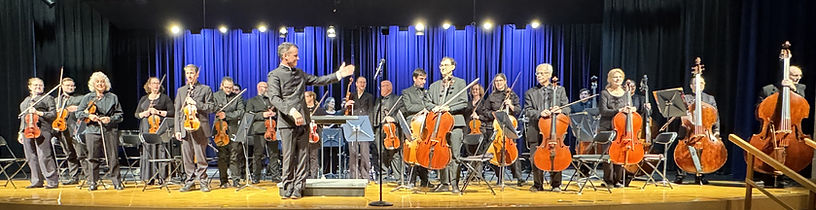
The 2025 - 2026 Concert Season
The Warren Philharmonic Orchestra's 58th season will featured two public concerts both on Saturday at Lakeview High School Auditorium, Cortland OH.
Media Coverage and Press Releases for the 2025-2026 Season:
Fall2025
-
"Valley to get double dose of Beethoven," Tribune Chronicle, Aug. 2-3, 2025, A4.
-
"WPO opens season with Fall Masterworks," Andy Gray, Tribune Chronicle, October 2, 2025, B9.
-
"Warren Philharmonic to Open Season with Masterworks," The Business Journal, October 1, 2025.
-
"Warren Philharmonic opens season October 4 with Beethoven, Wagner," Metro Monthly, October 1, 2025.
-
"Kids in Concert," Tribune Chronicle, October 4-5, 2025 Weekend Edition, p. A1.
-
Fall Concert Email Blast, Constant Contact, 9/19/2025.
-
Fall Concert Email Blast, Constant Contact, 9/28/2025.
Spring 2026
-
"Warren Philharmonic to present 'Sounds of Spring' on May 9." Metro Monthly, April 13, 2026.
-
Spring Concert Email Blast, Constant Contact, 4/26/2026.
-
"Spring Inspires WPO's Fanale," Tribune Chronicle, April 7, 2025, p. Sports-9.
Tickets/Subscriptions: 2025-2026 Season
Patrons: 2025-2026 Season
Program Advertisers: 2025-2026 Season

Saturday, May 9, 2026, 7:00 PM
Sounds of Spring
The Warren Philharmonic Orchestra Spring 2026 Concert will be held at the Lakeview High School, 300 Hillman Dr., Cortland, OH 44410.
Appalachian Spring (Ballet for Martha), Suite for 13 Instruments - Aaron Copland
Concerto in A Major for Piano and Orchestra No.23, KV 488 - Wolfgang Amadeus Mozart
I. Allegro
II. Adagio
III. Allegro assai
The Featured Soloist is Pianist Aleksandra Velgosha.
INTERMSSION
Symphony No. 6 in F Major ‘Pastorale’, Op. 68 - Ludwig van Beethoven
I. Allegro ma non troppo
II. Andante molto mosso
III. Allegro
IV. Allegro - Thunder Storm
V. Allegretto
INTERMISSION
Symphony No. 5 in D Minor - Dimitri Shostakovich
IV. Allegro non troppo
Side by side performance with the Youngstown State University Youth Orchestra.

For more information:
Flier for the 2025 - 2026 concert season
Full Program Bulletin Spring 2026
Program notes
Musicians for this Concert
Press Release [Word] [PDF]
Pianist Aleksandra Velgosha
Pianist Aleksandra Velgosha was born in Moscow, Russia. She is a doctoral candidate at James Madison University and enjoys an artistic life of teaching, collaborating, and performing solo. Her recent community initiative included the launching of an annual New Piano Music Symposium in 2024, where JMU composers and pianists collaborate to present new piano works to the local community. Aleksandra's achievements include first and second prizes in competitions like E. R. Davis Piano Competition, Crescendo Competition (Carnegie Hall, NY), and many others. Aleksandra has appeared in solo and collaborative performances throughout the United States and Europe and has performed at such festivals as Port City Music Festival, American Liszt Society Festival, and Staunton Music Festival. She appeared as soloist with such ensembles as Tula Regional Orchestra (Tula, Russia), New England Youth Ensemble (Takoma Park, MD), JMU Wind Symphony and JMU Brass Band (Harrisonburg, VA). Aleksandra received her BM in Piano Performance with honors from Washington Adventist University with Dr. Mark Di Pinto, and completed her master's degree at the University of Maryland under Prof. Larissa Dedova. Aleksandra studies at JMU with Dr. Gabriel Dobner and has taught at such institutions as University of Maryland, Christopher Newport University, Richardson School of Music, Takoma Academy, and Chanson Music School. She currently serves as an adjunct faculty at James Madison University.

Program Notes Spring 2026
Appalachian Spring Suite (for 13 instruments) (1944) – Aaron Copland
Dawn breaks on a farmhouse. One by one, instruments gather, offering messages of hope.
In 1942, Aaron Copland was asked for a new ballet score by the dancer and choreographer Martha Graham. Copland had watched Graham blaze a trail through 1920s New York. He’d seen her uncompromising physical language and understood its focus on the heaviness and intensity of the human body. Graham set Appalachian Spring in a Pennsylvania farmhouse, in the shadow of the Civil War. A couple is soon to be married. The wife-to-be is ambivalent, feeling joy and concern. There is tension as the couple clashes with a hellfire preacher.
Copland’s music reflects the varied influences of Graham’s story. Swing music, hymns, and folk-tinged melodies mingle, while the melody “Simple Gifts” reflects Copland’s interest in the Shakers, an insulated Christian sect focused on community, work, and simplicity.
He later made a suite from the ballet. Included is the hope of the morning, dances of celebration, ecstasy of religious experience. Gone is the darkness of the ballet’s second half: numbers like “Fear in the Night,” “Day of Wrath,” and “Moment of Crisis.”
The work’s title came from a Hart Crane poem, “The Dance.” The poem is baffling, but the “Appalachian spring” seems to refer to a water source as well as the annual season. When Copland asked if the poem had anything to do with the ballet, Graham answered, “No, I just liked the title and I took it.”
Concerto in A Major for Piano and Orchestra No. 23, KV 488 – Wolfgang Amadeus Mozart
This work dates from early 1786, when Mozart was in demand chiefly as a composer of vocal music – Le nozze di Figaro was taking shape at the same time. But the fickle Viennese public, which had three years earlier so lavishly acclaimed the piano concertos by the young virtuoso from Salzburg, was hardly clamoring for more. Mozart nevertheless went ahead with their composition, in the belief that he could seduce the public with his unquenchable ability to come up with something new and tantalizing.
Without question, there is something new in all three piano concertos he would produce even when his former patrons were seeking other musical sensations: the festive – and profound – Concerto in E-flat, K. 482; the dark, dramatic C minor, K. 491; and between those two giants, this lithe and gracious work in the key of A major, which it shares with the equally mellow Clarinet Concerto, his last instrumental composition. K. 488, like its two near contemporaries, was intended for Mozart’s own performance and all three were probably first heard at Lenten season concerts in 1786. All remained unpublished at his death.
The A-major Piano Concerto replaces the bright-toned oboes usually found in Mozart’s concertos with clarinets, for darker coloration, particularly in the passionate, richly chromatic slow movement in the rare key of F-sharp minor. But unlike K. 482 and K. 491, which likewise employ clarinets, there are no trumpets and drums here. The atmosphere remains intimate, with interchanges between the woodwinds – flute, clarinets, bassoons – heightening the chamber-music feeling of the first two movements; and while the rondo-finale may be a send-’em-home-smiling affair, it hardly lacks those passing touches of pathos without which Mozart simply wouldn’t be Mozart.
K. 488 has all the characteristics of the work of a wise old master, giving the impression of having seen and heard everything and having no regrets. And in a sense Mozart was old, at the age of 30.
Symphony No. 6 in F Major ‘Pastorale’ Op. 68 – Ludwig van Beethoven
Beethoven did most of the work on his Symphony No. 6 during the time he was completing the Fifth Symphony—late 1807 into early 1808—and in many ways, it is a walk down the sunny side of the same street. Bright and relaxed where the Fifth is dark and driven, the Sixth is nonetheless just as miraculously voiced and almost as tightly constructed.
There were precedents for a programmatic “Pastoral” such as this, particularly Le Portrait musical de la nature, a symphony of five similarly titled movements composed in 1784 by the music director for the Stuttgart court, Justin Heinrich Knecht. Beethoven, however, indicated that his intentions were more “an expression of feeling than of description.”
Years later, Beethoven took his friend and often unreliable biographer Anton Schindler for a walk in the country outside Vienna. “Here it was that I composed the ‘Scene by the Brook’ and the yellow buntings overhead, the quails, the nightingales, and the cuckoos composed with me,” Beethoven said. In the instrumental cadenza at the close of the “Scene by the Brook,” Beethoven marks the birdsongs in the score—the nightingale is the flute, the quail is the oboe, and the two unison clarinets represent the cuckoo. The yellow bunting is not labeled, but Beethoven indicated to Schindler its more important fluttering figure, appearing first in the flute.
The brook itself rolls along gently in the middle strings, and there are numerous other points of explicit scene painting. The insouciantly untutored musicians in the “Merry Gathering of Country Folk” depict the house band of Croatian folk musicians of a tavern named At the Three Ravens. Musical storms became a Romantic cliché, though few hit with the impact of Beethoven’s, despite the steady enlargement of both harmonic and instrumental palettes. Beethoven saves the timpani, trombones, and piccolo for this moment, as well as the minor side of the home key and unstable harmonies such as diminished chords.
So you can enjoy the day in Beethoven’s countryside without feeling guilty that you are ignoring the finer points of the purely musical argument. The birdsongs are not merely illustrative detail but are musically pertinent as well, for example, and the mellow radiance of the finale cloaks the structure of a cogent sonata form. In Beethoven’s “Pastoral” Symphony, appreciation of the lovingly detailed scenery and expressed feelings, as well as their abstract underpinnings, are one and the same, since Beethoven made them completely interactive. To notice a programmatic detail in this sonic country is also to observe a twist in the structural logic. Trust the feelings that Beethoven worked so hard to evoke.
Musicians for this concert

Patrons for the 2025-2026 Season
