

Support Your Orchestra!
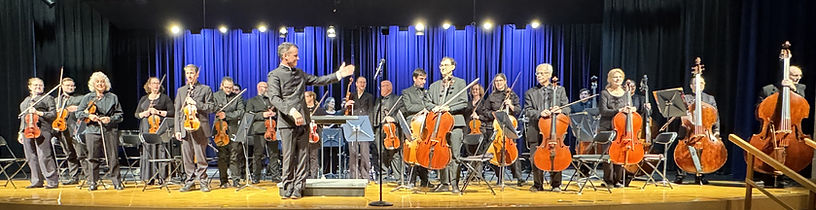
The 2025 - 2026 Concert Season
The Warren Philharmonic Orchestra's 58th season will featured two public concerts both on Saturday at Lakeview High School Auditorium, Cortland OH.
Media Coverage and Press Releases for the 2025-2026 Season
-
"Valley to get double dose of Beethoven," Tribune Chronicle, Aug. 2-3, 2025, A4.
-
"WPO opens season with Fall Masterworks," Andy Gray, Tribune Chronicle, October 2, 2025, B9.
-
"Warren Philharmonic to Open Season with Masterworks," The Business Journal, October 1, 2025.
-
"Kids in Concert," Tribune Chronicle, October 4-5, 2025 Weekend Edition, p. A1.
-
Fall Concert Email Blast, Constant Contact, 9/19/2025.
-
Fall Concert Email Blast, Constant Contact, 9/28/2025
Tickets/Subscriptions: 2025-2026 Season
Program Advertisers: 2025-2026 Season

Saturday, October 4th, 2025, 7:00 PM
Fall Masterworks
The program for the Fall 2025 Concert at Lakeview High School, Cortland, OH is as follows:
-
Overture to Egmont, 0p. 84 - Ludwig van Beethoven (1770 - 1827)
-
Siegfried-Idyll, WWV 103 - Richard Wagner (1813 - 1883)
-
Habanera - Emmanuel Chabrier (1841 - 1894)
~Intermission~
Symphony No. 4, Op. 90 ‘Italian’ - Felix Mendelssohn (1809 - 1847)
I. Allegro vivace
II. Andante con moto
III. Con moto moderato
IV. Salterello. Presto
For more information:
Flier for the 2025 - 2026 concert season
Full Program Bulletin Fall 2025
Program notes
Musicians for this Concert
Press Release [Word] [PDF]

October 4, 2025 Concert Photos

Warren Philharmonic Orchestra, Warren, OH

Warren Philharmonic Orchestra, Warren, OH

Warren Philharmonic Orchestra, Warren, OH
Warren Philharmonic Orchestra, Warren, OH
Fall Masterworks Program Notes
Warren Philharmonic Orchestra
Program Notes
4 October 2025
Overture to Egmont
Ludwig van Beethoven
As the musicologist Paul Mies has remarked, heroism was a major concern of Beethoven’s times. Not surprisingly, the composer gravitated toward protagonists who dared much against repressive forces in his rare forays into music for the theater.
Egmont is a case in point. In 1809 Beethoven was commissioned to compose incidental music for the Vienna revival of the play by Johann Wolfgang von Goethe (1749–1832). This was Goethe’s free interpretation of Count Egmont’s 16th-century struggle for Dutch liberty against the autocratic imperial rule of Spain. Egmont is imprisoned and sentenced to death, and when Klärchen, his mistress, fails to free him, she commits suicide. Before his own death, Egmont delivers a rousing speech, and his execution becomes a victorious martyrdom in a fight against oppression.
Beethoven’s incidental music begins with a powerful, strikingly original overture that summarizes the course of the drama, from its ominous slow introduction (suggesting the oppressive tread of Spain with the rhythm of a sarabande) to the manic transformation of tragedy into triumph in a brilliant coda, which Beethoven echoed at the end of the play as a “Symphony of Victory.”
—From the Los Angeles Philharmonic archive
Siegfried Idyll
Richard Wagner
Richard Wagner's Siegfried Idyll was a personal, intimate musical gift to his wife, Cosima, for her 33rd birthday and the first Christmas after their son Siegfried's birth, featuring motifs from his opera Siegfried, a lullaby, and personal references like "Fidi" (Siegfried's nickname) and the "orange sunrise" from their home in Tribschen. Originally for a small chamber ensemble, the work was later expanded for publication.
—Note by Michael Clive
Habanera
Emmanuel Chabrier
The French composer Emmanuel Chabrier (1841-1894) was greatly admired by a wide range of composers including Debussy, Stravinsky and Richard Strauss. He was also close to some of the finest painters of his age, and works he collected by artists like Claude Monet and Édouard Manet now hang in some of the finest museums in the world.
Chabrier and his wife toured Spain in 1882, and he was deeply impressed by the country and its music. When he returned to France, he wrote his best known work, a rhapsody for orchestra known as España, which was a huge and immediate success.
Two years later he wrote a lesser known, but very beautiful, work for piano called Habanera. He reworked the music a bit and orchestrated it in 1888, producing a lovely miniature for orchestra.
Habanera is the name used outside of Cuba for the contradanza, an elegant dance style that was especially popular in Cuba in the 19th century.
—Note by Bruce Brown
Symphony No. 4, “Italian”
Felix Mendelssohn
Mendelssohn went to Italy in October 1830. The trip lasted 10 months—he started in Venice and worked his way south to Rome, stopping in Bologna and Florence along the way. During his stay in Rome, he witnessed the coronation of Pope Pius VIII and the city’s festivities during Holy Week (the week leading up to Easter). From Rome, he went on to Naples and visited Pompeii before returning to Germany through Genoa and Milan.
His impressions of the trip were recorded in a series of watercolors and sketches—Mendelssohn was a decent amateur artist—and in the present Symphony. There is nothing particularly Italian about the symphony until its final movement. Rather, the work strives more to convey a series of impressions of Italy—Mediterranean sunshine, religious solemnity, monumental art and architecture, and open countryside.
The symphony opens with a burst of sound—woodwinds and pizzicato strings—whose irrepressible eighth notes become the accompaniment to a jubilant string melody. The winds play an especially prominent role in this movement, with Mendelssohn treating them with a great degree of freedom that gives the movement a transparent, airy texture. It’s like a musical rendition of the Italian blue sky that impressed Mendelssohn.
In the second movement, an Andante con moto in D minor, Mendelssohn recalls the impressive processions he had witnessed during his time in Rome. He evokes these with a dusky melody (oboes, clarinets, and violas) that unfolds over an ambling bass line. This alternates with two contrasting, relaxed, major-key sections.
The flowing minuet (Con moto moderato), with its legato writing for strings and winds, offers a musical equivalent of the symmetrical forms and restrained beauty of some of the architecture Mendelssohn saw during his Italian sojourn. The trio sounds vaguely militaristic, with its fanfare-like melodic figure for horns and bassoons.
In the finale, Mendelssohn uses another dance, the raucous Neapolitan saltarello, as the basis of the movement. He never relaxes the tension during the movement, which hurtles to a close with a minor-key reiteration of the first movement’s opening theme.
—Note by John Mangum
Musicians For The Fall 2025 Concert
Violin I
Barton Samuel Rotberg,
Concertmaster
Jay Koziorynsky**
Gloria Slocum
Carrie Singler
Kristen Van-Dyck
David Timlin
Violin II Brendan Considine, Principal
Karen Considine
Maria Vinãs
Erick Ramos
Richard Smrek
Viola
Jamie Thornburg, Principal
Jenna Barvitski
Hillary Lenton
Victoria Goettel
Cello
Jeffrey Singler, Principal
David Londoño
Kayrusan Quintero
Kyung Won Jeon
Bass
Jeffrey Bremer, Principal
Justin Bendel
Flute
Kathryn Thomas Umble,
Principal
Stephanie Carter-Dennis
Oboe
Sarah Bates-Kennard, Principal
Virginia Kao
Clarinet
Alice Wang, Principal
Joseph Mansfield
Bassoon
Janice Pylinski, Principal
Joseph Kan
Horn
Laura Makara, Principal
Van Parker
Deborah Jenness
Rebecca McGown
Trumpet
Jay Villella, Principal
Christopher Krummel
Timpani
Donald Yallech, Principal
Concert Manager & Librarian
*Jay Koziorynsky

Patron/Contributors List - 2025-2026
The Warren Philharmonic Orchestra is pleased to acknowledge the support of the following individuals, foundations, and corporations whose generosity to the WPO helps keep the music playing. We appreciate those donors who wish to remain anonymous. If your gift has not yet been recognized in print, the Orchestra will do so in a future issue of this program.
Please accept our sincere thanks in advance.
Maestro's Circle ($10,000.00 and above)
AVI Foodsystems
Elizabeth Barrickman and William Mullane
Platinum Baton Club ($5000 - $9999)
Ohio Arts Council
Gold Baton Club ($1000 - $4999)
Carole Lewis
Dan and Carol Olson
Judith Rae Solomon
Conductor's Club ($500 -$999)
Brian and Alison Bodor
Amber Rogers
Robert and Beth Walton
Benefactor ($200 - $499)
Mr. and Mrs. Robert Burkey
Salvatore Coppola
Michael and Laurie Keriotis
TJ Lynn
Janet McGeough
Marianne Nissen

Sustaining ($100 - $199)
Karen Brown
Dennis Freet
Thomas and Claudia James
Peter Rossi
Contributor ($50 - $99)
David and Laura Boich
Kimberly Dobson
Jackie Mills-James
Dianne Martin
Kevin Wyndham
Friend (Up to $49)
Brenda Crouse
Jill Merola
Jane Pollis
In-Kind Service Donations
The Warren Symphony Society wishes to express deep gratitude for the support of the following individuals and companies who
provided much-needed service to the WPO.
Technical & Clerical Support
Barry and Leanna Dunaway
Ginger Letourneau
Judy Solomon
Concert Reception & Social Hours
Dr. and Mrs. Robert Walton
Program Notes
Dr. Christopher M. Cicconi
Audio/Video Technical Support
Deborah Murphy
Facilities for Meetings
Trumbull Art Gallery
The Trumbull County Abstract Co.
Website Design
Deborah Murphy
Facebook
William Mullane
Brochure Distribution
Trumbull County Abstract Co.
Trumbull County Tourism Bureau
Trumbull Art Gallery
Rotary Club of Warren, Ohio
Local Churches-All Denominations
Venue for Concerts
Lakeview High School Auditorium
Graphic Design & Printing
RC Graphics
Student Concert
The Warren Philharmonic Orchestra is committed to playing a vital role in the Music Education and Community Outreach for Trumbull County Students. A free student concert will be offered to all Trumbull County students on October 3, 2025. It will be held at Lakeview Auditorium at 10AM for those in 3rd grade up to 7th grade.
At the concert, students will be given the opportunity to explore the stories behind the music and may well be asked to "conduct" the Orchestra for a "hands on" experience. The selection of music will come from the October 4th evening concert.
-
Overture to Egmont, 0p. 84 - Ludwig van Beethoven (1770 - 1827)
-
Siegfried-Idyll, WWV 103 - Richard Wagner (1813 - 1883)
-
Habanera - Emmanuel Chabrier (1841 - 1894)
-
Siegfried-Idyll WWV 193- Richard Wagner

Warren Philharmonic Orchestra

Warren Philharmonic Orchestra

Warren Philharmonic Orchestra
Warren Philharmonic Orchestra
Program Advertisers: 2025 - 2026
Full Page
B & I Management Co.
JR Solomon Architect
Mayfair Laundromats
Trumbull County Abstract Company
Quarter Page
Saturday, May 9, 2026, 7:00 PM
Sounds of Spring
The Warren Philharmonic Orchestra Spring 2026 Concert will be held at the Lakeview High School, 300 Hillman Dr., Cortland, OH 44410.
Appalachian Spring (Ballet for Martha), Suite for 13 Instruments - Aaron Copland
Concerto in A Major for Piano and Orchestra No.23, KV 488 - Wolfgang Amadeus Mozart
I. Allegro
II. Adagio
III. Allegro assai
The Featured Soloist is Pianist Aleksandra Velgosha.
INTERMSSION
Symphony No. 6 in F Major ‘Pastorale’, Op. 68 - Ludwig van Beethoven
I. Allegro ma non troppo
II. Andante molto mosso
III. Allegro
IV. Allegro - Thunder Storm
V. Allegretto
INTERMISSION
Symphony No. 5 in D Minor - Dimitri Shostakovich
IV. Allegro non troppo
Side by side performance with the Youngstown State University Youth Orchestra.
For more information:
Flier for the 2025 - 2026 concert season
Full Program Bulletin Spring 2026
Program notes
Musicians for this Concert
Press Release [Word] [PDF]
Pianist Aleksandra Velgosha was born in Moscow, Russia. She is a doctoral candidate at James Madison University and enjoys an artistic life of teaching, collaborating, and performing solo. Her recent community initiative included the launching of an annual New Piano Music Symposium in 2024, where JMU composers and pianists collaborate to present new piano works to the local community. Aleksandra's achievements include first and second prizes in competitions like E. R. Davis Piano Competition, Crescendo Competition (Carnegie Hall, NY), and many others. Aleksandra has appeared in solo and collaborative performances throughout the United States and Europe and has performed at such festivals as Port City Music Festival, American Liszt Society Festival, and Staunton Music Festival. She appeared as soloist with such ensembles as Tula Regional Orchestra (Tula, Russia), New England Youth Ensemble (Takoma Park, MD), JMU Wind Symphony and JMU Brass Band (Harrisonburg, VA). Aleksandra received her BM in Piano Performance with honors from Washington Adventist University with Dr. Mark Di Pinto, and completed her master's degree at the University of Maryland under Prof. Larissa Dedova. Aleksandra studies at JMU with Dr. Gabriel Dobner and has taught at such institutions as University of Maryland, Christopher Newport University, Richardson School of Music, Takoma Academy, and Chanson Music School. She currently serves as an adjunct faculty at James Madison University.

Program Notes Spring 2026
Appalachian Spring Suite (for 13 instruments) (1944) – Aaron Copland
Dawn breaks on a farmhouse. One by one, instruments gather, offering messages of hope.
In 1942, Aaron Copland was asked for a new ballet score by the dancer and choreographer Martha Graham. Copland had watched Graham blaze a trail through 1920s New York. He’d seen her uncompromising physical language and understood its focus on the heaviness and intensity of the human body. Graham set Appalachian Spring in a Pennsylvania farmhouse, in the shadow of the Civil War. A couple is soon to be married. The wife-to-be is ambivalent, feeling joy and concern. There is tension as the couple clashes with a hellfire preacher.
Copland’s music reflects the varied influences of Graham’s story. Swing music, hymns, and folk-tinged melodies mingle, while the melody “Simple Gifts” reflects Copland’s interest in the Shakers, an insulated Christian sect focused on community, work, and simplicity.
He later made a suite from the ballet. Included is the hope of the morning, dances of celebration, ecstasy of religious experience. Gone is the darkness of the ballet’s second half: numbers like “Fear in the Night,” “Day of Wrath,” and “Moment of Crisis.”
The work’s title came from a Hart Crane poem, “The Dance.” The poem is baffling, but the “Appalachian spring” seems to refer to a water source as well as the annual season. When Copland asked if the poem had anything to do with the ballet, Graham answered, “No, I just liked the title and I took it.”
Concerto in A Major for Piano and Orchestra No. 23, KV 488 – Wolfgang Amadeus Mozart
This work dates from early 1786, when Mozart was in demand chiefly as a composer of vocal music – Le nozze di Figaro was taking shape at the same time. But the fickle Viennese public, which had three years earlier so lavishly acclaimed the piano concertos by the young virtuoso from Salzburg, was hardly clamoring for more. Mozart nevertheless went ahead with their composition, in the belief that he could seduce the public with his unquenchable ability to come up with something new and tantalizing.
Without question, there is something new in all three piano concertos he would produce even when his former patrons were seeking other musical sensations: the festive – and profound – Concerto in E-flat, K. 482; the dark, dramatic C minor, K. 491; and between those two giants, this lithe and gracious work in the key of A major, which it shares with the equally mellow Clarinet Concerto, his last instrumental composition. K. 488, like its two near contemporaries, was intended for Mozart’s own performance and all three were probably first heard at Lenten season concerts in 1786. All remained unpublished at his death.
The A-major Piano Concerto replaces the bright-toned oboes usually found in Mozart’s concertos with clarinets, for darker coloration, particularly in the passionate, richly chromatic slow movement in the rare key of F-sharp minor. But unlike K. 482 and K. 491, which likewise employ clarinets, there are no trumpets and drums here. The atmosphere remains intimate, with interchanges between the woodwinds – flute, clarinets, bassoons – heightening the chamber-music feeling of the first two movements; and while the rondo-finale may be a send-’em-home-smiling affair, it hardly lacks those passing touches of pathos without which Mozart simply wouldn’t be Mozart.
K. 488 has all the characteristics of the work of a wise old master, giving the impression of having seen and heard everything and having no regrets. And in a sense Mozart was old, at the age of 30.
Symphony No. 6 in F Major ‘Pastorale’ Op. 68 – Ludwig van Beethoven
Beethoven did most of the work on his Symphony No. 6 during the time he was completing the Fifth Symphony—late 1807 into early 1808—and in many ways, it is a walk down the sunny side of the same street. Bright and relaxed where the Fifth is dark and driven, the Sixth is nonetheless just as miraculously voiced and almost as tightly constructed.
There were precedents for a programmatic “Pastoral” such as this, particularly Le Portrait musical de la nature, a symphony of five similarly titled movements composed in 1784 by the music director for the Stuttgart court, Justin Heinrich Knecht. Beethoven, however, indicated that his intentions were more “an expression of feeling than of description.”
Years later, Beethoven took his friend and often unreliable biographer Anton Schindler for a walk in the country outside Vienna. “Here it was that I composed the ‘Scene by the Brook’ and the yellow buntings overhead, the quails, the nightingales, and the cuckoos composed with me,” Beethoven said. In the instrumental cadenza at the close of the “Scene by the Brook,” Beethoven marks the birdsongs in the score—the nightingale is the flute, the quail is the oboe, and the two unison clarinets represent the cuckoo. The yellow bunting is not labeled, but Beethoven indicated to Schindler its more important fluttering figure, appearing first in the flute.
The brook itself rolls along gently in the middle strings, and there are numerous other points of explicit scene painting. The insouciantly untutored musicians in the “Merry Gathering of Country Folk” depict the house band of Croatian folk musicians of a tavern named At the Three Ravens. Musical storms became a Romantic cliché, though few hit with the impact of Beethoven’s, despite the steady enlargement of both harmonic and instrumental palettes. Beethoven saves the timpani, trombones, and piccolo for this moment, as well as the minor side of the home key and unstable harmonies such as diminished chords.
So you can enjoy the day in Beethoven’s countryside without feeling guilty that you are ignoring the finer points of the purely musical argument. The birdsongs are not merely illustrative detail but are musically pertinent as well, for example, and the mellow radiance of the finale cloaks the structure of a cogent sonata form. In Beethoven’s “Pastoral” Symphony, appreciation of the lovingly detailed scenery and expressed feelings, as well as their abstract underpinnings, are one and the same, since Beethoven made them completely interactive. To notice a programmatic detail in this sonic country is also to observe a twist in the structural logic. Trust the feelings that Beethoven worked so hard to evoke.

Patrons for the 2025-2026 Season
